
The Arpeggiator, and How to Hear It
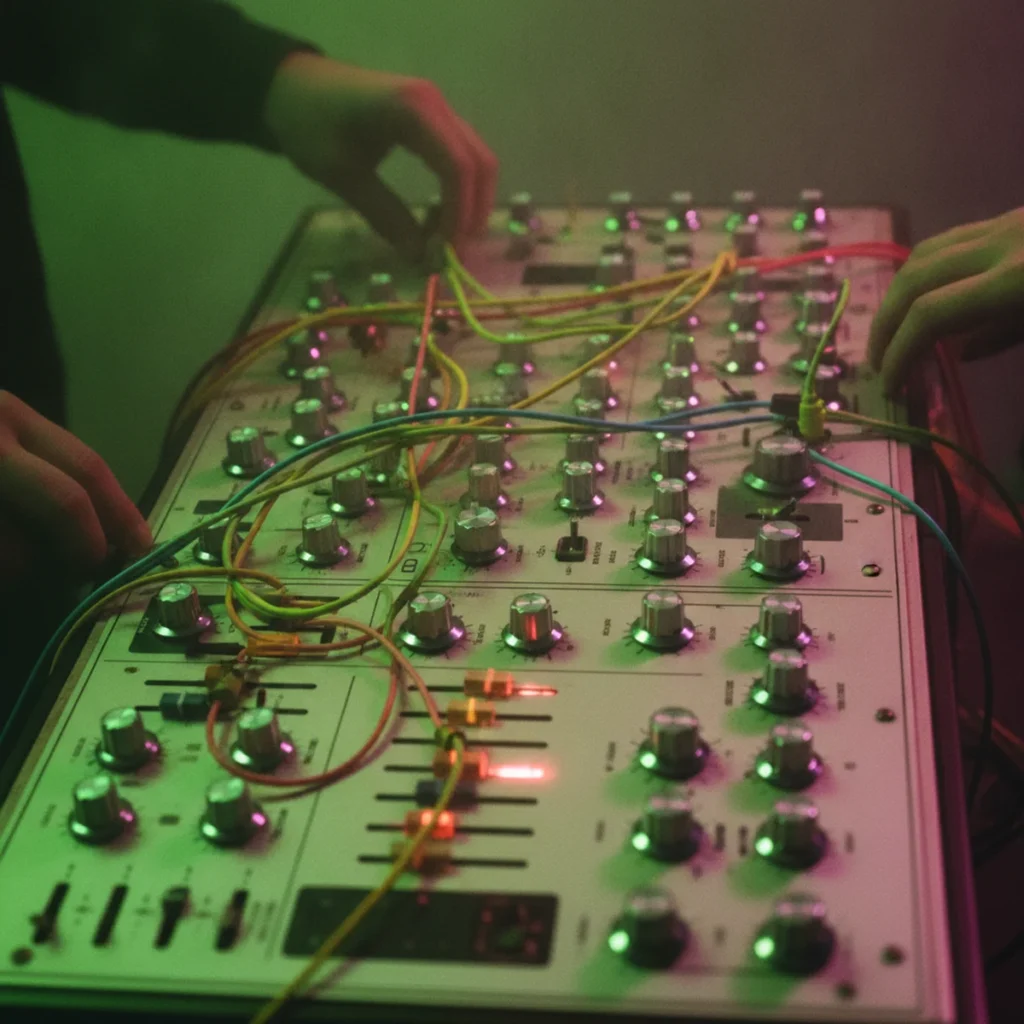
A held chord played back as a pattern. Simple, mechanical, and responsible for a great deal of the genre.
The arpeggiator takes a chord you are holding and plays its notes one at a time in a set order. That is the whole idea, and it shaped decades of electronic pop.
You can listen to our full playlist which contains the artist’s music, and know more about the artist’s work by scrolling down the page.

PLAYLIST
A Held Chord, Played Back in Order
The arpeggiator takes the notes of a chord being held down and plays them one at a time in a defined order, in time with a clock. That is the entire idea, and it shaped decades of electronic pop.
The controls are correspondingly simple: the order the notes are played in, the rate, the range in octaves, and whether the pattern latches so it continues after the keys are released.
Its importance comes not from complexity but from what it made possible for people who were not keyboard players, which was most of the people making early electronic pop.
It Solved a Practical Problem
Early synthesisers were frequently monophonic, playing one note at a time, which meant chords were unavailable and sustained harmonic backing was impossible.
An arpeggiator turns a chord into a sequence a monophonic instrument can play, so the harmony is implied through motion rather than stated simultaneously. That gave a single-voice instrument a way to carry harmonic content.
It also produced perfectly regular timing at speeds no player could sustain, which meant a producer with limited keyboard technique could generate fast, precise, continuously moving parts.

The Sound Is Mechanical on Purpose
What distinguishes an arpeggiated part from a played one is the absolute regularity: identical timing, identical velocity, no variation across bars.
That mechanical quality was initially a limitation and became the point. It sits with the synthetic timbres to produce something deliberately non-human, which is a large part of what electronic pop was communicating.
Attempts to humanise arpeggiated parts with timing and velocity randomisation generally weaken them, because the regularity is doing the expressive work rather than getting in its way.
Learning to Hear It
Identifying an arpeggiator in a mix is a learnable skill, and the tells are consistent once known.
Listen for a repeating pattern of single notes at a constant rate, where the notes are all members of the current chord and the pattern changes shape only when the chord changes. Held-note sustain and vibrato will be identical on every note.
The clearest confirmation is at chord changes. A played part usually varies its figuration; an arpeggiated one applies the same directional pattern to whatever new notes are held, so the contour repeats exactly against different pitches.

Interaction With the Filter Is the Craft
The reason arpeggiated parts do not become tedious across a whole track is usually filter movement rather than any change in the notes.
Slowly opening a filter across a section transforms a static pattern into something that develops continuously, and adding resonance makes each note’s attack sing at the cutoff frequency as it sweeps.
That combination — mechanical note pattern, continuously moving timbre — is the core technique. The pattern supplies momentum and the filter supplies the arc, and neither works nearly as well without the other.
Why It Has Not Dated
Unlike many production techniques of its era, arpeggiation has never really gone away, and it appears across genres that share nothing else.
The reason is that it solves a general problem rather than expressing a period style. It creates continuous motion, implies harmony and fills space with a single held gesture, which is useful in any arrangement.
Modern implementations add pattern editing, per-step control and complex rhythmic subdivision, but the core function is unchanged from the original circuits, and a plain up-pattern at a steady rate remains one of the most reliable devices available.

About The Author

 The FM Synth Sound and Where It Went
  Analogue and Digital, and What Actually Differs
  Why Synth-Pop Keeps Coming Back
  Presets Are Not Cheating
  Vocoder, Talkbox, Auto-Tune: Three Different Machines
  The Drum Machines That Built Genres
  The Sync Pipeline for Synth Music
  What Software Emulation Gets Right
  Why Synth-Pop Does Well on Playlists
  Sidechain Is Not the Only Way to Make Space