
Analogue and Digital, and What Actually Differs
The real differences are drift, filter behaviour and aliasing. Most of the rest is folklore.
The analogue-versus-digital argument produces more heat than information. There are genuine measurable differences, and they are narrower and more interesting than the usual claims.
You can listen to our full playlist which contains the artist’s music, and know more about the artist’s work by scrolling down the page.

PLAYLIST
The Argument Produces More Heat Than Information
The analogue-versus-digital debate in synthesis generates a great deal of confident assertion and comparatively little measurement, which is unfortunate because the genuine differences are both real and interesting.
Most of the standard claims — warmth, depth, life — are not defined precisely enough to test, and when the underlying properties are identified they usually turn out to be specific, describable behaviours rather than an overall quality.
Three differences do hold up under examination: oscillator drift, filter behaviour under load, and aliasing. Almost everything else attributed to the distinction is a consequence of one of those or of the instrument’s design rather than its technology.
Drift Is the Largest Audible Difference
Analogue oscillators do not hold pitch perfectly. They vary slightly with temperature, supply voltage and component tolerance, and they never sit at exactly the specified frequency.
That instability is the single most audible characteristic of analogue synthesis. When several oscillators play the same note while drifting independently, the result is a continuously shifting phase relationship — a chorusing thickness that a perfectly stable digital oscillator does not produce.
It is entirely reproducible digitally by adding controlled randomness, and most modern software does exactly that. The difference is that in an analogue instrument the imperfection is unavoidable, while digitally it is a parameter someone chose to include.

Filters Behave Non-Linearly Under Drive
The second genuine difference is in filter behaviour, particularly when pushed hard.
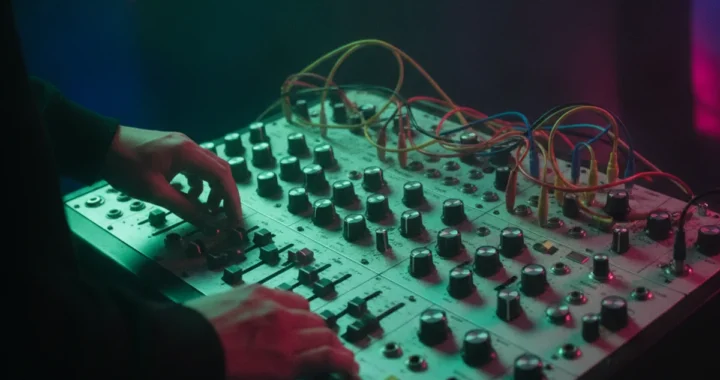
Analogue filters are built from components that behave predictably within a range and non-linearly outside it. Driven hard, they saturate, distort and interact with resonance in complex ways that depend on the specific circuit.
This is the hardest part to model accurately, because it requires simulating component behaviour rather than a mathematical transfer function. Modern modelling does it well, and it is computationally expensive, which is why cheaper digital filters historically sounded thin at high resonance.
Aliasing Is a Digital-Only Problem
The third difference runs the other way, being a defect that only digital systems have.
A digital oscillator generating a harmonically rich waveform produces harmonics above half the sample rate, which fold back into the audible range as inharmonic content that has no musical relationship to the note. It is most obvious on high notes with bright waveforms.
Well-designed digital oscillators avoid this using band-limited synthesis or heavy oversampling. Poorly designed ones do not, and a great deal of what people identified as digital harshness in earlier instruments was aliasing rather than anything inherent to digital synthesis.

Most Perceived Differences Are Design, Not Technology
Beyond those three, the differences people report usually trace to design decisions rather than to the underlying technology.
An analogue instrument with one knob per function invites a different working method from a digital one navigated through menus, and the resulting sounds differ because the interaction differed. That is an interface effect, not a circuit effect.
Signal path also matters. Many analogue instruments include output stages, transformers and amplifiers that colour the sound noticeably, and that colouration is frequently attributed to the oscillators or filters that did not produce it.
Which Is Worth Choosing
Given all that, the practical answer is that the question is usually the wrong one.
Analogue instruments offer immediacy, physical interaction, genuine unpredictability and a signal path with character. Digital offers recall, polyphony, stability, synthesis methods that analogue cannot implement, and no aliasing when properly built.
Neither is more capable in general, and records made entirely with each are indistinguishable to most listeners in most contexts. The interesting decision is which working method suits the person using it, which has very little to do with the technology argument.

About The Author

 The FM Synth Sound and Where It Went
  Why Synth-Pop Keeps Coming Back
  The Arpeggiator, and How to Hear It
  Presets Are Not Cheating
  Vocoder, Talkbox, Auto-Tune: Three Different Machines
  The Drum Machines That Built Genres
  The Sync Pipeline for Synth Music
  What Software Emulation Gets Right
  Why Synth-Pop Does Well on Playlists
  Sidechain Is Not the Only Way to Make Space