
Why Synths Took Over Film Scoring
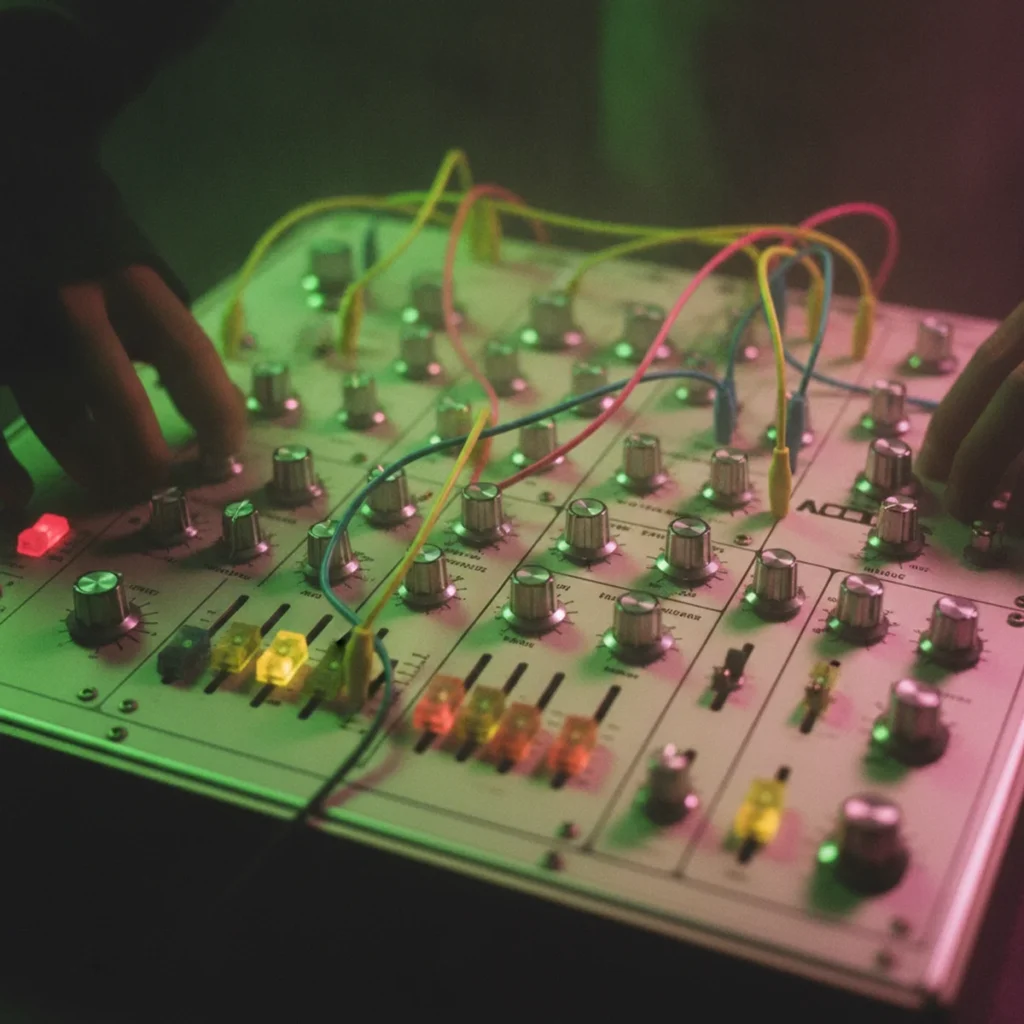
Cost, control and the ability to sustain a note forever.
Synthesised scores went from novelty to default across a few decades, and the reasons are practical before they are aesthetic.
You can listen to our full playlist which contains the artist’s music, and know more about the artist’s work by scrolling down the page.

PLAYLIST
Cost Came First
Synthesised scores moved from novelty to default across a few decades, and the reasons were practical well before they were aesthetic.
An orchestral score requires composition, orchestration, copying, a large number of players, a scoring stage, an engineer and a conductor. It is one of the more expensive line items available to a production.
A synthesised score requires a composer and a room. For television, independent film, documentary and games, that difference is not marginal; it determines whether original music is possible at all.
Control Matters as Much as Cost
The second practical driver is revision. Film music is written against picture that keeps changing, and every change requires the music to change with it.
With an orchestral recording, a re-edit means re-recording, which means booking players again. With a synthesised score, it means moving material in a sequencer, and the composer can do it that afternoon.
Directors also want to hear options. A synthesised score allows a composer to present three approaches to a scene the same week, which is impossible when each version has an orchestra attached to it.
Turnaround expectations are the practical driver most often understated. A television composer may have days rather than weeks, and no orchestral process fits that schedule regardless of budget, which alone accounts for a great deal of the shift.

Sustain Is a Genuine Musical Advantage
Beyond economics there is a specific musical capability that synthesis offers and acoustic instruments do not, and it suits film unusually well.
A synthesiser can hold a note indefinitely without a bow change, a breath or a decay. That makes sustained, unresolving textures straightforward, and those textures are extraordinarily useful for maintaining tension across a long scene.
An orchestra can approximate it with staggered bowing and breathing, but the result has a natural pulse to it. Synthesis produces genuine stasis, which is a different and sometimes more effective dramatic tool.
Sound Design and Score Merged
A structural change followed: the boundary between the score and the film’s sound design became difficult to locate.
When a score consists partly of processed textures and tones rather than played notes, and the sound design includes pitched, musical elements, the two disciplines overlap substantially. Many contemporary scores contain material that is not identifiable as music in the traditional sense.
That has been productive creatively and has complicated credits and workflow, since it is no longer always clear which department a given sound belongs to.
Synthesis also permits sounds with no acoustic origin at all, which suits science fiction and horror specifically. A score that needs to signal something outside ordinary experience benefits from timbres that have no real-world referent.

Hybrid Is Now the Default
The dominant approach is not synthesis replacing orchestra but the two combined, and the combination is now standard on large productions.
A typical score might use a real string section for emotional material, synthesised elements for tension and texture, and processed hybrids for anything requiring scale beyond what an orchestra produces.
This gets the human quality of played instruments where it matters and the control and cost advantages of synthesis everywhere else, which is why it has become the default rather than a compromise.
The Aesthetic Argument Came Last
Having been adopted for practical reasons, synthesised scoring acquired an aesthetic identity, and it now carries specific associations.
Certain palettes read immediately as futuristic, others as period, and a synthesised score is now a deliberate genre signal rather than merely a budget decision.
That completes an interesting inversion. The technique entered scoring because it was cheap and flexible, and it stayed because it turned out to do things an orchestra cannot, which is close to the opposite of how it was originally justified.
Sample libraries complicated the categories further. A modern score frequently uses sampled orchestral instruments played from a keyboard, which is neither a synthesised score nor a recorded one, and the credits rarely distinguish.

About The Author

 The FM Synth Sound and Where It Went
  Analogue and Digital, and What Actually Differs
  Why Synth-Pop Keeps Coming Back
  The Arpeggiator, and How to Hear It
  Presets Are Not Cheating
  Vocoder, Talkbox, Auto-Tune: Three Different Machines
  The Sync Pipeline for Synth Music
  What Software Emulation Gets Right
  Why Synth-Pop Does Well on Playlists
  Sidechain Is Not the Only Way to Make Space