
Purity Ring Cut Lemonlime From an Album and Used It to Launch a Tour
The Korg M1 is the best-selling digital synthesiser ever built, a 1988 workstation whose factory piano and organ presets are stamped across three decades of house, pop and R and B records. It is also, in 2026, the machine at the centre of a Purity Ring track. lemonlime arrived on 14 April, and the M1 is not buried in it as a texture. It is the thing the song is arranged around.
That choice tells you what kind of release this is. Purity Ring have spent their career building sounds that are difficult to trace back to a specific box, layering down-pitched vocals and heavily side-chained percussion until the source is unrecoverable. Reaching for one of the most identifiable digital synths in existence, and letting it stay identifiable, is a different move. The duo call the result glitch-haze, which is as good a description as any.
What a Korg M1 Is Doing on a 2026 Record
The M1’s presets became so ubiquitous in the 1990s that producers spent the following decade trying to avoid them. Their return has been steady rather than sudden, helped along by software recreations that put the same waveforms in front of anyone with a laptop. What separates a considered use from a lazy one is arrangement, and on lemonlime the M1 is surrounded rather than showcased.
According to mxdwn Music, the track sets the synth against dappled percussion, scattered synth flourishes and twinkling arpeggios. That is a deliberately open arrangement for a duo whose earlier records ran dense. The percussion is placed rather than programmed into a wall, and the arpeggios move in the upper register where the M1’s brightness sits naturally rather than fighting the vocal.
Part of what makes the machine awkward to use well is that its character is fixed. The M1 was a sample-plus-synthesis workstation, meaning its tones start from short recorded waveforms rather than raw oscillators, and those waveforms are the same ones that saturated the charts for a decade. There is no filter sweep that disguises them. A producer either accepts the association and builds around it, or picks a different instrument. Purity Ring accept it, and the song is more legible for the decision than their earlier work usually allows.
The Song That Was Written First and Released Last
The sequencing story is the interesting part. lemonlime was the first song written during sessions for the duo’s self-titled fourth album, and it did not make the final tracklist. That album, Purity Ring, came out on 26 September 2025 through 4AD and Last Gang, trailed by the double single many lives and part ii in June and Place of My Own in July.
What it did not fit is worth spelling out, because that album was unusually structured. Purity Ring was conceived under the influence of role-playing video games, Final Fantasy X and NieR: Automata among them, and built to function as something close to a soundtrack for one. Two digital avatars of the duo set off on a journey to build a kinder world among the ruins of a broken one, and the running order carries that arc. A record organised as a narrative has less room for a strong standalone song than a conventional album does, which is a structural reason for a cut rather than a quality judgement.
Songs get cut from albums constantly, usually because they do not fit. Releasing the cut track seven months later, as the closing statement of the same album cycle, reframes it: not an offcut but a bookend. The duo have described the song as one about survival, and about caring for someone living with a chronic illness, summarising it as a sad dream if you wake up. The central lyric, quoted by Dork, runs “I’m a mirror mirror of you / Without body we’re the same / Now I’m tired, but I’ll hold on to you / As if nothing, nothing’s changed”.
Glitch-Haze as a Working Description
Self-applied genre tags are usually marketing. This one is closer to a production note. Glitch implies deliberate digital artefacts, the stutters and micro-edits that come from cutting audio at sample boundaries rather than musical ones. Haze implies the opposite instinct, long reverb and unresolved high-frequency content that blurs edges. Doing both at once means committing to a mix where sharp transient detail and smeared ambience share the same space.
It is consistent with how the pair have always worked. Their catalogue is built on down-pitched and distorted vocals, on percussive and vocal loops, and on aggressive side-chaining, the technique where one signal ducks the volume of another in rhythm. Applied hard, side-chaining is what produces the breathing, pulsing quality that has been Purity Ring’s signature since Shrines in 2012.
The Instrument That Runs the Lights
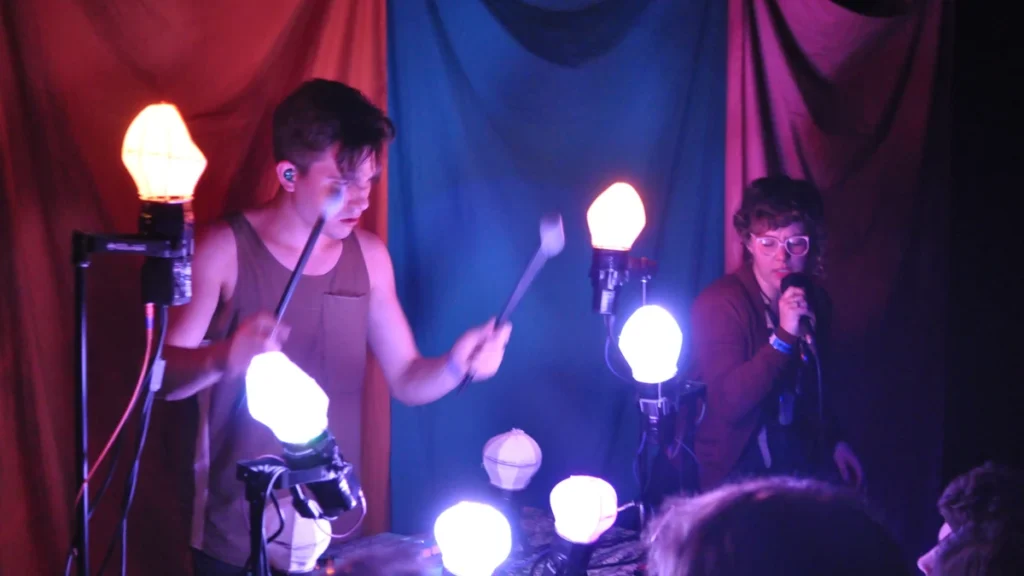
Live, Corin Roddick plays a custom-built, tree-shaped instrument that drives both the sound and the lighting, so that every strike is simultaneously a note and a visual cue. It is an unusual piece of engineering because it collapses two production roles into one performance: there is no lighting operator interpreting the music, because the music is the lighting.
The division of labour behind it has shifted over time. Roddick has handled instruments and production since the duo formed in Edmonton in 2010, with Megan James on vocals; James has been credited as a producer since 2020. Their working method changed too. Shrines was assembled with Roddick emailing instrumentals for James to sing over, while Another Eternity in 2015 was the first record they made in a studio together.
The catalogue between those poles is more varied than the four-album count suggests. Womb arrived in 2020 with the singles Pink Lightning, Stardew and Peacefall, the last featuring Jonas Bjerre, and the Graves EP followed in 2022. Alongside that runs a thread of collaborations reaching outside their own register, from Belispeak II with Danny Brown in 2012 to Shines with Black Dresses in 2023. All four albums have come through 4AD and Last Gang, which is an unusually stable label relationship for an electronic act across fourteen years.
A Tour Built to Fill In the Gaps
The Place of My Own tour opened in Sacramento at Ace of Spades on 17 April, three days after the single, and it was explicitly an extension rather than a fresh cycle: a run through the North American cities the autumn 2025 dates had missed. April took in San Jose, Santa Ana, Tucson, El Paso, Albuquerque, San Antonio, Houston and New Orleans.
May pushed east and then north, through Orlando, St. Petersburg, Jacksonville, Greensboro, Pittsburgh, Boston, Norwalk, Toronto, Detroit, Milwaukee, Indianapolis, St. Louis, Kansas City and Oklahoma City, before turning west via Fort Collins, Boulder, Spokane, Portland and Vancouver. It closed the North American leg on 28 May in Anchorage, a routing choice most touring acts at this scale skip entirely. James’s solo project MMJ opened the North American dates.
Australia After a Decade Away
June took the tour offshore for the first time in roughly ten years. Brisbane came first on the 10th at Open Season at The Tivoli, then Melbourne’s Northcote Theatre on the 11th and Sydney’s Metro Theatre on the 13th. The 14th brought Hobart and Dark Mofo, the winter festival whose programming leans toward exactly the sort of act whose live show is a lighting rig as much as a set.
Europe followed quickly: London’s Outernet on 18 June and the Metronome Festival in Prague on the 20th. Two dates is a small European presence for a band with four albums on 4AD, but paired with the Australian run it reads as a deliberate reach into territories that had gone unserved rather than an attempt at full coverage.
Where the Album Era Ends
With the tour finished and lemonlime released, the self-titled cycle is closed. Wikipedia’s discography lists a further single, Bitter Rhymes, in July 2026, which suggests the pair did not pause long. Whatever follows, the M1 arrangement is a useful marker: a band who spent fifteen years making sounds hard to identify choosing, at the end of a record cycle, to build a song on a machine everyone can name.
That instinct is not confined to them. The wider return of late-1980s and 1990s digital hardware has been one of the defining production stories of the decade, a pattern we traced in more detail here. What Purity Ring add is restraint: one recognisable synth, an open arrangement around it, and a song held back for seven months until it had somewhere useful to go.
About The Author

 The Hip-Hop Dance-Pop Sound and Where It Went on Hold Me Close Now! By Gloria May Byron
  Why Chillwave Keeps Coming Back: Goodbye Gravity by Attaboy
  Why Synth-Pop Keeps Coming Back, as Shoshan Dunamis Shows on Have a Sense
  Bright Arpeggios Under a Heavy Heart, and How to Hear Them on LNNY’s Gehen Rafatape Remix
  Summer Shame: F. Scott’s Unearthly Opening Notes and Where They Went
  Four Versions of One Hook on What I Should See by Peter Agyagos, and How to Hear It