
Daniel Casares Dresses One Alto Sax as Whales, Screams and a Fake Soprano on Sounds of a Digital City

Daniel Casares Dresses One Alto Sax as Whales, Screams and a Fake Soprano on Sounds of a Digital City
A Spanish Jazz Guitarist Builds Glitch From Free Samples, iPhone Clips and His Own Sax
The whale calls near the end of Sounds of a Digital City are not whales. They are the Lux alto saxophone of Daniel Casares, sent through so much reverb that it stops sounding like a saxophone. The jazz guitarist, composer and producer from A Coruña, Spain, released the eight-track album on 10 April 2026.
Daniel Casares’s Sounds of a Digital City sits in the playlist below, and his coverage is collected on his artist profile. The album came to this desk through PopHits.Co Music Charts, which verifies independent artists and places their releases across its network of music news desks. Press play, then read on.

That trick is the key to the whole record. Casares trained in jazz at Berklee College of Music from 2014 to 2018. He also led a weekly set at Wally’s Jazz Cafe in Boston. Here, though, his main tool is a saxophone pushed until it plays other parts. So this piece takes the album apart in three stages: the hook, the sources, and the way each track is built.
One Lux Alto Supplies the Hooks, Harmonies and Screams on Sounds of a Digital City by Daniel Casares
Start with the saxophone, because it does most of the work. Casares recorded his Lux alto through a Shure SM57, then gave it a new job on almost every track. strike up was the first track he made for the album. There it plays a wild solo over a distorted synth riff and a breakbeat he sequenced himself.
city noise turns the same alto into a fake soprano, pitched up and soloing over a second breakbeat. For calm madness it runs through a vocalizer, so one sax plays its own harmonies over a MIDI organ he played live. And on hits, a track built on sax and synth hits, the screams are the saxophone too.
Then comes doober, where the whales live. The alto goes under tons of reverb during the track’s underwater interlude, among bubbly samples. It comes out as something closer to a sea creature than a jazz instrument.

Free Sample Libraries, an iPhone and a DIY Studio in Rural Galicia Supply the Rest
The other sounds come from places most producers would skip. Many of the glitchy textures, synth basses and drum sounds started in the copyright-free Glitch For Friends sample series. Casares edited, resampled and rebuilt them until they fitted. He also played further parts from Kontakt and Reaktor live on a MIDI keyboard.
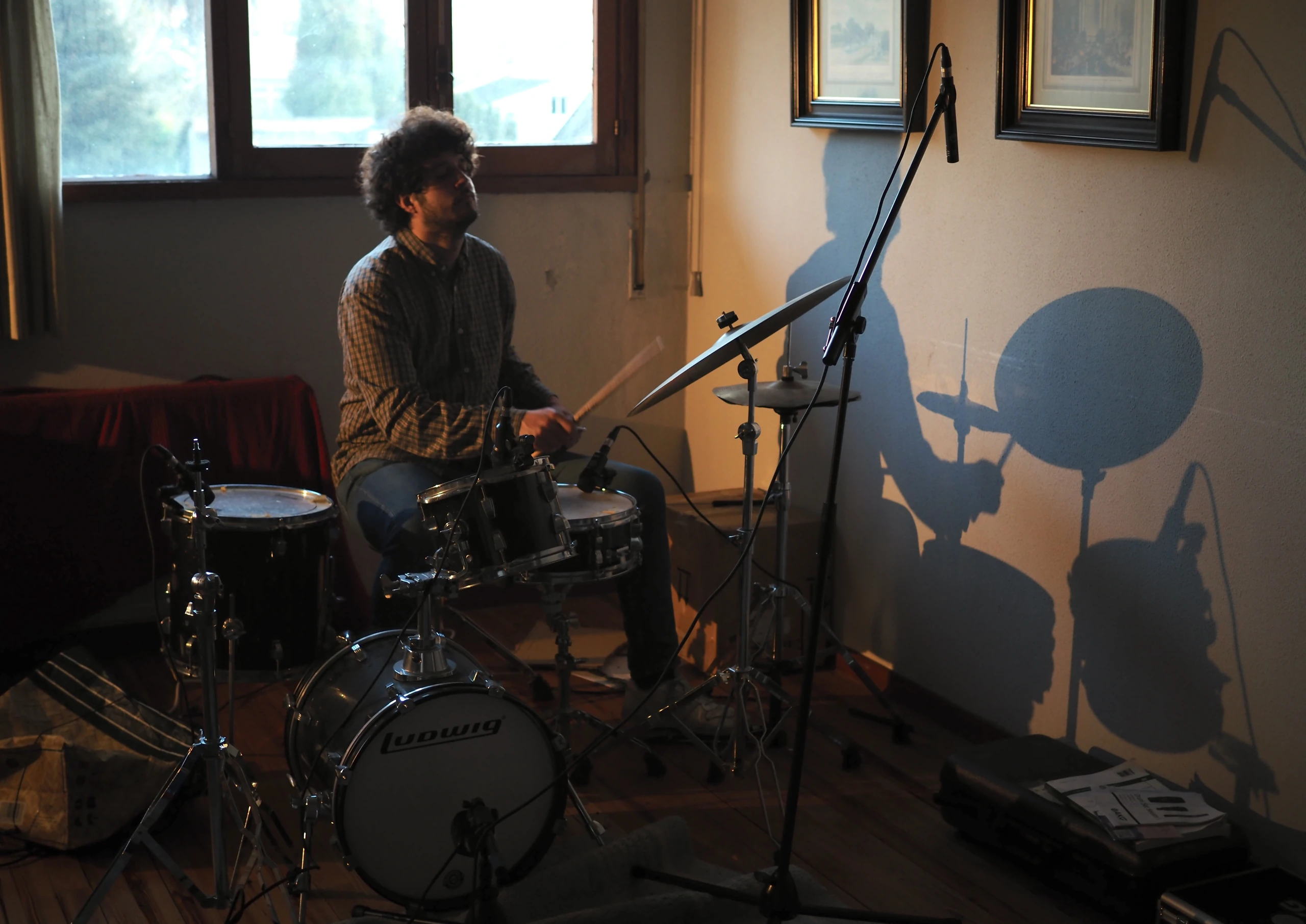
His phone is an instrument as well. Recordings he made on an iPhone turn up across the album. On city noise, for one, a clip of an exciting sports moment goes through a multi-pitch plug-in. In the second half of altered state, a real Ludwig Questlove drum kit with Zultan cymbals takes over, recorded with a set of AKG Drum Set Session I microphones.
All of it went through a short list of plug-ins, among them the Soundtoys Decapitator, the iZotope suite, the Waves J37 and Magma BB Tubes. The room was his DIY studio in rural Galicia. He recorded the album there in two and a half days, once working from midday until ten the next morning.
“I rarely use patches, as I build most of my sounds myself, and when I do use them I manipulate them very much to fit my specific vision,” Casares explains.
Daniel Casares, credited as Daniel Garrido Casares, composed the music of Sounds of a Digital City, and he also produced it and played the saxophone.

Sounds of a Digital City Builds Its Tracks in Two Halves and Ends on a Looped Free Jazz Recording
The structure is the third piece of craft. Eight tracks last 14 minutes and 26 seconds in total, and four of them fit two distinct parts into under three minutes each. city noise has two halves with a short interlude between them. altered state starts on a busy beat programmed on a digital drum machine in Kontakt. Then it drops to half-tempo for its acoustic drums, a soaring sax solo and a glitched voice sample.
transforming, the longest track at two minutes and 52 seconds, is the centrepiece. A first part of breakbeat and glitchy layers leads into an interlude of sounds pitched up and down. Then an energetic breakbeat runs over sampled fast jazz drums, and a two-note synth melody pushes it forward.
His own guitar steps out on engine, as a fast, relentless solo with a little bit crusher on its sound. Underneath are chopped samples from an underground digital hardcore track and a jazz track featuring a saxophone. And the album ends on doober, where a free jazz recording fades in over the rest until it is left alone and looped.
Colin Stetson and Amon Tobin Took the Same Two Roads as Daniel Casares on Sounds of a Digital City
Two artists help explain the method. Colin Stetson turned the saxophone into a whole ensemble with extended techniques: circular breathing, multiphonics, altissimo, percussive valve-work, clicking keys and growling. Casares gets his range the other way. He uses reverb, pitch-shifting and a vocalizer rather than his breath.
Amon Tobin built Bricolage (1997) and Permutation (1998) from jazz instrument samples. By Foley Room (2007) he recorded every sample himself with an omnidirectional microphone. The sources ran from motorbikes and tigers to insects and water from a tap. Casares sits between the two stages, with free libraries on one side and his own iPhone clips on the other.
From the ElectroPop.News curator team: “Sounds of a Digital City is a lesson in reuse: a sample pack, a phone and one saxophone, with nothing left in its factory setting.”
Play doober first, find the whales, and then go back to strike up and hear where the saxophone started.
Stream Sounds of a Digital City by Daniel Casares on Apple Music and Bandcamp. Follow Daniel Casares on Spotify, Apple Music, Instagram, his YouTube channel and his website.








About The Author

 Writing PTSD Into a 140 BPM Synth Pulse, and How to Hear It on FIRELAND by Prianca RA
 Kylie Minogue’s Fever Turns 25 With B-Sides and Remixes on a Second Disc
 Sean Pitaro Asks Who Is Busy Collecting Souls Before partner in crime Reaches Its Chorus
 From a Homemade Sequencer to the Rock Hall, New Order Arrive Divided
 Why the Sci-Fi Concept Album Keeps Coming Back, on Solivagant by Skiffska and Its Astronaut, Emma
 Changer de décor Saves One Changed Line for the Last Chorus, Where Nick Dalk Stops Running
 Daniel Casares Dresses One Alto Sax as Whales, Screams and a Fake Soprano on Sounds of a Digital City