
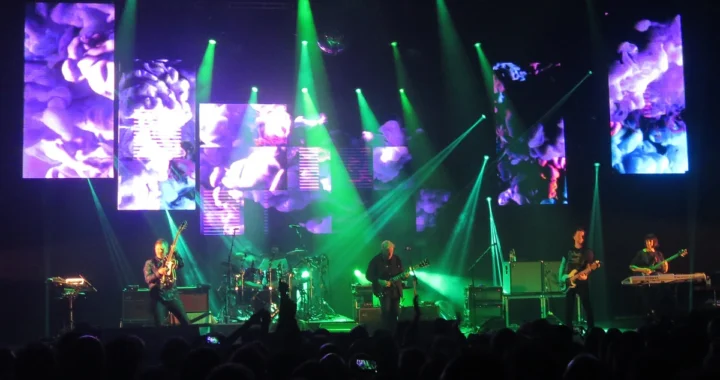
From a Homemade Sequencer to the Rock Hall, New Order Arrive Divided
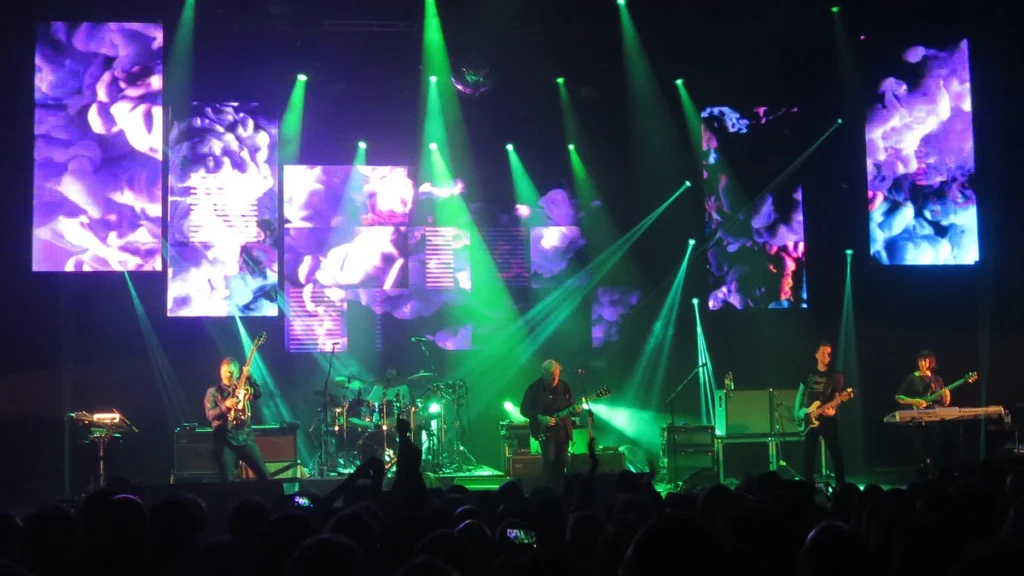
The sequencer behind Blue Monday had no screen and no MIDI. Every step had to be entered as an on or an off, in binary, and the bar lengths it produced could not be edited once they were down. That stubborn little box, made for New Order by a professor Bernard Sumner knew, sits at the start of the road that ends on Saturday, 14 November, when Joy Division and New Order are inducted into the Rock & Roll Hall of Fame in Los Angeles.
The people who programmed that record will not be standing together when it happens. Stephen Morris and Gillian Gilbert are staying in England, Sumner has said nothing in public about the honour, and bassist Peter Hook has spent the year explaining why he will not share a podium with his former bandmates. Here is how the machines made the record, and why the band that built it arrives at the Hall divided.
How Blue Monday Was Programmed Before MIDI
Hook told the story in detail to SPIN in August. Money from Joy Division’s records after the death of singer Ian Curtis in 1980 let the new band buy equipment, and the drummer and the singer led the spending. “Stephen and Barney in particular really wanted to invest in the new technology that was becoming available. Most of it was American. The one we were using was an Oberheim DMX,” Hook said.
The rest of the rig was American too. Hook was playing a Sequential Circuits Prophet-5 and a Moog, and the band had the homemade sequencer, which he described as something “this professor Barney knew had made and mocked up.” Nothing spoke a common language. “If I remember rightly, this was before MIDI and it was control voltage,” Hook told SPIN, and the band were working in Britannia Row, Pink Floyd’s studio in London, where the new machines had to be wired into an older room.
The song itself began as a way to avoid playing encores. “Barney came up with a great idea of why don’t we program something and then we can play it and go off and get drunk,” Hook said. Their manager, Rob Gretton, heard the programmed track and kept pushing them to put a bass part and a vocal on it. Hook added the bass, and Gretton suggested one of its phrases would work as the vocal line, which is how the melody arrived. The finished mix was done by hand, with several people riding the faders across one desk.
The Mistakes You Can Still Hear
The best parts of Blue Monday were not planned. “The interesting thing about ‘Blue Monday’ is the interesting bits, the little one bar breaks and stuff that really make it hop, were all mistakes,” Hook told SPIN. “They should have been two bars and four bars, instead they were one bar and three bars.”
Because the sequencer could not be rewritten, those odd lengths stayed. “Once it was down on time, you were stuck with it,” he said. That is the detail worth listening for on a modern system. In the short drop-down sections, where the ear expects a break of two or four bars, the record gives one or three, and the pattern springs back early. In a conventional arrangement those breaks would have been tidied into twos and fours. Here the machine fixed them in place, and they became the spring in the record.
There is no conventional chorus, either. Hook called the vocal “a random collection of melodies and words,” which suits a song that started life as an instrumental for the band to leave running on stage. Sequencer, drum machine and bass guitar carry the hooks; the singing sits on top of them rather than leading.
A 12-Inch That Lost Money on Every Copy
New Order released Blue Monday in 1983 as a 12-inch single, and refused to cut a radio edit. The record’s die-cut sleeve cost more to make than the single earned. “We lost 50 pence on every copy of ‘Blue Monday’ because of the holes and the die cast,” Hook said.
The audience found it anyway. DJs across Europe played the 12-inch through the summer, British holidaymakers heard it abroad and came home asking for it, and the label pressed it again that winter. According to SPIN, it reached No. 9 on the UK singles chart, spent 38 weeks in the Top 75 and 186 weeks on the UK independent chart, and became the best-selling 12-inch single in history. “‘Blue Monday’ was like a sonic assault and weirdly it still sounds great today,” Hook said.
SPIN credited Joy Division and New Order with bridging 1970s punk and post-punk and 1980s electronic dance music, leaving a blueprint for bands working in art-rock, modern synth-pop and alternative dance. The American hardware at the centre of that story is still a starting point for electronic writers: on this site we recently covered how Broken Fears wrote a soundtrack for dancers starting on a Moog Grandmother.
What the Rock Hall Is Inducting on Saturday
The Hall is inducting the two bands together, as one entry in the performer category. Joy Division had been eligible since 2003 and got in on its third nomination, the San Francisco Chronicle reported. The ceremony takes place at the Peacock Theater in downtown Los Angeles and, after two years of live streams, will not be seen until an edited version airs on ABC and Disney+ in December.
Not everyone in the band sees the joint entry as a compliment. In a Rolling Stone interview in September, reported by Stereogum, Morris said: “We only get in as a doubleheader. We got Joy Division/New Order. It’s kind of like, are we a bargain-basement thing?” He also admitted that awards in general leave him cold: “I’ve got to hold my hands up and say… I don’t get awards.”
He was careful to add that he was not ungrateful and called the induction fantastic. Days later the band clarified a misunderstanding from that interview: it is Gilbert, not Morris, who is living with cancer, and she asked for privacy while she continues her treatment.
Who Will Be in the Room for New Order
Morris and Gilbert will remain in England while she is treated, Rolling Stone reported on Thursday. Earlier in the year the couple stepped back from New Order’s touring line-up, which leaves Sumner as the only founding member on the band’s South American dates, starting on 23 November in São Paulo.
Sumner is about to cross the Atlantic for that tour anyway, Rolling Stone pointed out, but he has not said a word in public about the Hall of Fame. Hook’s representative declined to say whether he would attend, the Chronicle reported. And unlike previous years, the Hall has not published a list of presenters or guest performers, so nobody outside the organisation knows who will play Love Will Tear Us Apart or Blue Monday on the night.
Inductions with key members absent are not new; Rolling Stone pointed to Dire Straits in 2018, when Mark Knopfler stayed home. But for a band whose best-known record was built so the musicians could leave the stage and let the machines play, an induction without the full group carries a particular irony.
The Peter Hook Question
Hook left New Order in 2007 and the dispute that followed included years of legal action. In April he told Rolling Stone, as reported by Stereogum, that he would not stand with his former bandmates at the podium: “No. No. Not after what they did to me and my family, no… I won’t stand with them.”
He left one door open. “If Bernard pops his head around and goes, ‘Hey Hooky, sorry about that eight-year legal battle that cost you six years’ wages. I’m really sorry about it. We should maybe have just had a chat about it.’ So you never know, dear. Life is full of surprises,” Hook told the magazine. By August the mood had not improved. “Amazingly, we’re still at DEFCON 3 together at the moment, which is crazy considering we split up 19 years ago,” he told SPIN, adding that he had received a legal letter over a recent interview.
Morris, for his part, told Rolling Stone that Hook “didn’t seem happy in New Order” and did not seem happy playing New Order songs. There is a scheduling twist, too: Hook’s son and bandmate, Jack Bates, is due to play with the Smashing Pumpkins at the Darker Waves festival in Huntington Beach on the same night, about 40 miles away.
Where the Sequencer Goes Next
Whatever happens at the Peacock Theater, the songs will be played live this winter by two separate bands. Sumner’s New Order head for South America, and Hook’s band, the Light, plan a North American tour after the induction playing New Order’s 2001 album Get Ready in full, SPIN reported, with Blue Monday still in the set.
That split is the strangest legacy of a record made by a machine. A sequencer that could not be edited fixed the band’s mistakes into a dance-floor standard, and four decades later the people who programmed it are still at odds. The Hall’s edited broadcast in December will show which of them turned up.
About The Author

 Why the Sci-Fi Concept Album Keeps Coming Back, on Solivagant by Skiffska and Its Astronaut, Emma
 Changer de décor Saves One Changed Line for the Last Chorus, Where Nick Dalk Stops Running
 The Gross Beat Sound Behind The Spot by Vonenzo Baschello, and Where It Went
 Elly Xia Turns RIGHT WHERE I WANT HIM Into a Hyperpop Hook for the Shy, Nerdy Boys She Likes
 The Inanna Myth in Five Songs Made on a Phone by Nyna Grace, and How to Hear It
 In/Out by NIC AIMVIL and Eipo Puts a Taiwanese Voice at the Centre of German Electropop
 From a Homemade Sequencer to the Rock Hall, New Order Arrive Divided