
Carpenter Brut Closed an Eight-Year Trilogy With Leather Temple
A darksynth album that opens on a church organ is telling you something before the first drum hits. Ouverture (Deus Ex Machina) runs one minute and fifty seconds, it is built on big organ sounds, and its function is to frame everything after it as the last act of something rather than the start. Leather Temple came out on 27 February 2026 through No Quarter Prod, and it closes a story Franck Hueso began eight years earlier.
The Leather trilogy started with Leather Teeth in 2018 and continued on Leather Terror in 2022. Ten tracks and roughly 38 minutes finish it. That is a short record by the standards of concept albums, and the brevity is the point: Hueso has never made long records, and the arc resolves at the speed of the soundtrack it has always half-pretended to be.
How the Trilogy Ends
The narrative moved a long way across three albums. Leather Teeth opened with a protagonist who was a young student in love and not yet the killer the second record would make him; Hueso said at the time he wanted the sequel darker and more violent, and Leather Terror duly turned into a revenge story. Leather Temple jumps the frame entirely into a dystopian future, where a rebellion led by Lita Connor confronts a tyrant called Iron Tusk to free the oppressed.
Vengeance carries through all three, which is the connective tissue rather than any recurring character. Track titles do most of the narrative work: She Rules the Ruins, Iron Sanctuary, The Misfits / The Rebels, Speed or Perish. Nothing on the record is sung as exposition, so the story lives in the sequencing, the sleeve art and the titles, exactly as it does in the B-movie soundtracks the project has always been modelled on.
That restraint is worth crediting, because the temptation with a third act is to explain. Hueso does not. There are no spoken-word interludes stitching the arc together and no narrator establishing who Iron Tusk is, which means a listener arriving at the trilogy from its ending loses nothing musically. The lore rewards the people who followed it and stays out of the way of everyone else, and that balance is harder to strike than it sounds.
The Overture and the Saxophone
Two moments break the darksynth template deliberately. The organ overture is one. The other is Neon Requiem, three minutes and twenty-three seconds in the middle of the album, which slows down and brings in a saxophone. The Razor’s Edge heard it as a turn toward the 1980s pop culture of the Human League and Gary Numan, which is a reasonable read of what a sax does in this context: it dates the music, on purpose, to a decade the whole genre is arguing with.
Around those two, the record behaves. Major Threat is built on pulsating beats and was singled out as the strongest electronic track on it. The title piece is shadowy and heavy. She Rules the Ruins is the most cinematic thing here, carrying a 1990s synthetic pulse and an industrial hardness the same reviewer thought would make Trent Reznor proud, which is not a throwaway comparison given how Hueso approaches the live show.
Thirty-Eight Minutes, Ten Tracks
The running order is tightly built. After the overture, Major Threat runs 4:48 and Leather Temple 3:35, then She Rules the Ruins at 3:27 and Start Your Engines at 3:53. Neon Requiem sits at the centre as the breather. Iron Sanctuary and The Misfits / The Rebels follow at 3:37 and 3:32, the latter reaching into expansive drum and bass territory, and Speed or Perish drives at 4:30.
Then The End Complete takes six minutes and one second, half again as long as anything else, and closes on an orchestral arrangement. Reviewers reached for the same image: a warm embrace after a fierce battle. Placing the only long track last, and the only orchestral one, is how you signal an ending without writing a word of it. Thibault Chaumont mixed and mastered the album at Deviant Lab.
The economy of that sequencing deserves a second look. Seven of the ten tracks sit between three and a half and four minutes, which is pop single length, not album-track length, and the effect is that the record never idles. Darksynth has a standing weakness for the long build, where a producer spends two minutes arriving at a riff that then repeats until the fade. Almost nothing here does that. The overture is the only piece under three minutes, the closer is the only one over five, and everything between them states its idea early and leaves.
The Deliberate Facelessness
Hueso was born in Poitiers in 1977 and has described the project’s beginnings as a joke. He has stayed largely anonymous since, and he has been explicit that this is a choice rather than shyness: keeping the identity of the musician out of view puts the weight on the music instead. In a genre built on pastiche of an era, that is also a practical decision, because a faceless act can occupy a fictional world more convincingly than a photographed one can.
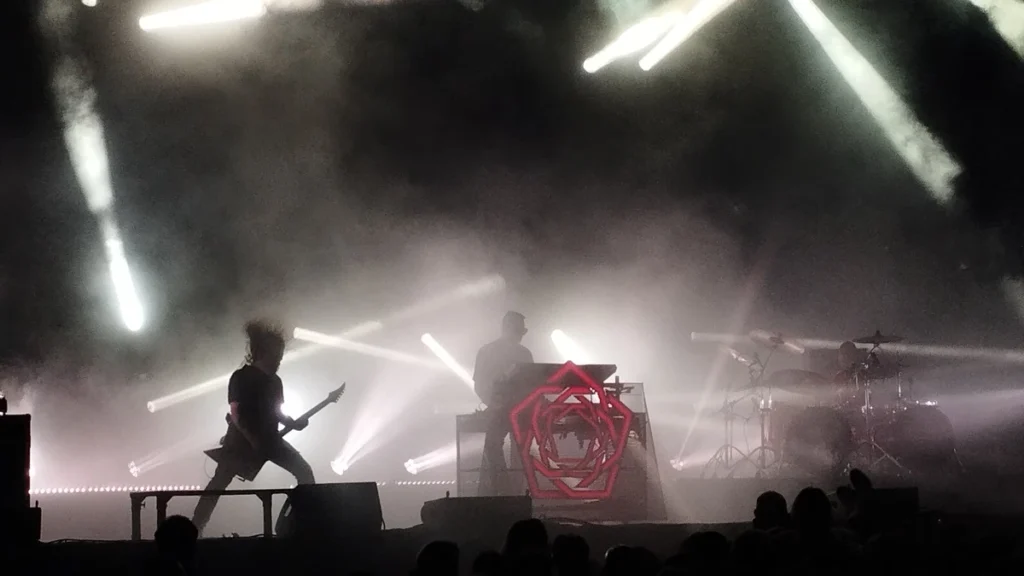
The live show is the opposite of understated. Hueso has said his model is Trent Reznor’s, on the principle that if he is going to play live it needs to be huge, and the touring band reflects that: Adrien Grousset on guitar and Florent Marcadet on drums, both from the French metal band Hacride, with visuals by Silver Strain projected behind them. It is a synth project staffed by metal musicians, which is the clearest statement of where darksynth actually sits.
What Darksynth Took From Metal
The Hacride connection is not incidental casting. Synthwave as a broad genre inherited its melodic language from film scores and its production habits from 1980s pop, but darksynth specifically borrowed its structure from heavy music: riffs that repeat and escalate rather than sections that develop, distortion applied to synthesised sources the way a pedal chain treats a guitar, and drum programming that hits like a kit rather than a machine.
That is why guitar and live drums sit comfortably on this material instead of sounding grafted on. The Bandcamp listing tags the album across 1980s, electronic, electro, French touch, horror and synthwave, and the spread is honest, because no one of those covers it. A record that can hold an organ overture, a saxophone interlude, a drum and bass passage and an orchestral finale inside 38 minutes is not really operating inside a single genre’s rules.
The Catalogue Around It
The trilogy is not the whole picture. Hueso released EP I in 2012 and EP II in 2013 on BlackBvs Records, then EP III and the compilation Trilogy in 2015 on No Quarter Prod, where he has stayed since. CarpenterBrutLive followed in 2017, and in 2020 he scored Blood Machines, which remains the clearest evidence that the soundtrack framing was never only an aesthetic pose.
He has also worked steadily outside his own records, with Greg Puciato on Imaginary Fire and with Gunship on The Widow Maker, both in 2022, and more recently contributing to The Midnight’s 2025 album Syndicate. Those collaborations map the two directions the project pulls in, one toward heavy music and one toward the melodic end of synthwave, and Leather Temple draws on both.
Why the Ending Matters
Concept trilogies in electronic music usually fail at the third instalment, because the world-building outgrows the songs and the record becomes an artefact for people already invested. This one avoids that by keeping the music legible on its own terms: Start Your Engines works as synthwave whether or not you can name Iron Tusk, and the organ and saxophone are audible decisions rather than lore.
It also closes a project at a moment when the wider 1980s revival shows no sign of exhausting itself, a pattern we have looked at before. Hueso spent eight years on a single arc and finished it rather than extending it, which in a genre that rewards indefinite pastiche is the least predictable move available to him.
About The Author

 The Hip-Hop Dance-Pop Sound and Where It Went on Hold Me Close Now! By Gloria May Byron
  Why Chillwave Keeps Coming Back: Goodbye Gravity by Attaboy
  Why Synth-Pop Keeps Coming Back, as Shoshan Dunamis Shows on Have a Sense
  Bright Arpeggios Under a Heavy Heart, and How to Hear Them on LNNY’s Gehen Rafatape Remix
  Summer Shame: F. Scott’s Unearthly Opening Notes and Where They Went
  Four Versions of One Hook on What I Should See by Peter Agyagos, and How to Hear It