
Perturbator Put His Sixth Album Out on a Metal Label
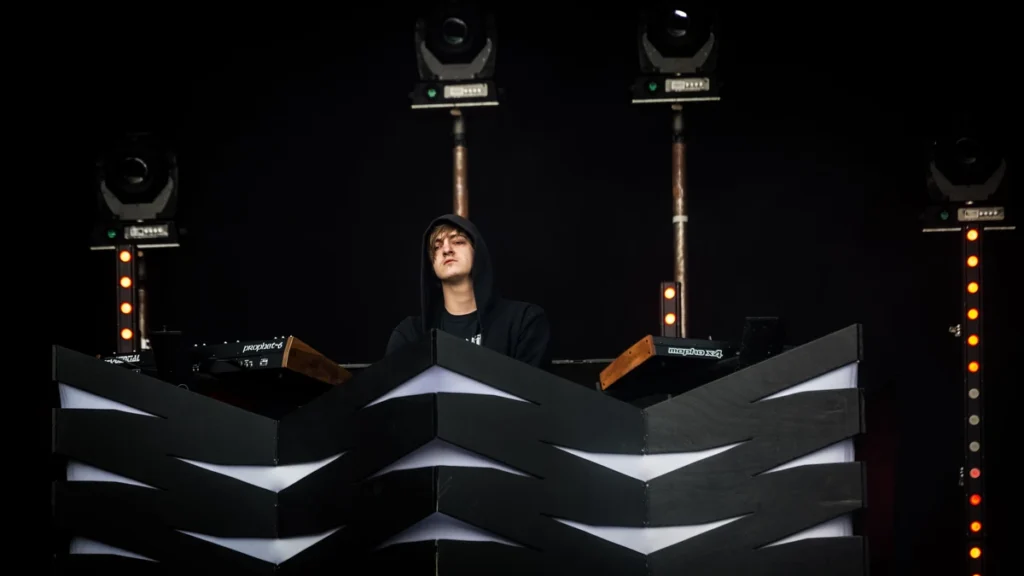
Look at who reviewed Age of Aquarius. Kerrang gave it four out of five. Metal Hammer gave seven out of ten. Rock Hard gave eight, Blabbermouth seven and a half. That is the entire critical record for the sixth album by an artist filed under synthwave.
James Kent released it through Nuclear Blast on 10 October 2025, having spent five albums on Blood Music. Nuclear Blast is one of the largest metal labels in the world, and by signing to it Kent formalised something his audience had understood for a decade.
The Guest List Is the Argument
Ulver open the record on Apocalypse Now, six minutes long, with a video directed by David Fitt. Author & Punisher, the industrial doom project built around custom-fabricated machines, appear on Venus. Greta Link sings on Lady Moon. Alcest, the French band who effectively invented blackgaze, close the album on the ten-minute title track.
Three of those four come from the harder end of European extreme music, and none from electronic production. An artist assembling that list is not borrowing credibility from a neighbouring scene; he is stating which scene he is actually in.
He Played in Black Metal Bands First
The biography explains it. Kent was born in Paris in 1993 and played guitar in several black metal bands before starting Perturbator in 2012. The synthesiser came second.
His parents make the story odder still. He is the son of Nick Kent, the British music critic who defined a certain kind of writing at the NME in the 1970s, and Laurence Romance, a French music journalist. Both had also been tech trance musicians, which is where the interest in synthesisers came from. Very few producers arrive with that particular combination of inheritance.
A Video Game Made Him
The mainstream exposure came from Hotline Miami, whose 2012 and 2015 instalments used his music and put it in front of an audience that had no connection to the retrowave scene. His stated influences run to cyberpunk and to films including Akira, Ghost in the Shell and The Running Man.
That is a different route into the same place. A game soundtrack reaches people through play rather than through listening, and it delivered him an audience already conditioned to associate the sound with violence and speed. The metal press was simply the first music writing to take that audience seriously.
What the Record Is About
Kent has described the album as having two halves, standing for conflict and for individualism, and has put the underlying position plainly: group-thinking leads nowhere, and having your own free will is the single most essential thing we have in life.
The first single, The Art of War, released in April 2025, came with a more specific explanation. He described it as being about our propensity to make everything a spectacle and how we consume acts of violence as entertainment, which is a pointed thing to say from a producer whose breakthrough came through a game about killing people.
An Hour Long
Eleven tracks run fifty-nine and a half minutes, which is long by the standards of a genre built on short, propulsive instrumentals. Apocalypse Now, Lunacy, Venus, The Glass Staircase, Hangover Square, The Art of War, 12th House, Lady Moon, The Swimming Pool, Mors Ultima Ratio and the title track.
Five of them pass five minutes and the closer runs past ten. Metal Hammer’s verdict was that at the core of each of the eleven songs is a cracking idea; Kerrang described the result as a seamless, looming whole of industrial, post-punk and electronica. Blabbermouth called it an imperious display of originality and ingenuity.
Rock Hard’s review contained the most useful reservation, noting that he lands the most effective hits when he goes hard and fast. That is a fair note on an album that spends a good deal of its running time on atmosphere, and it identifies the trade being made: length bought texture at some cost to impact.
Why the Metal Press Took It
The reception is worth dwelling on because it is genuinely unusual. Electronic music made with synthesisers and no live drummer does not normally get a Kerrang cover story, and metal magazines have historically been hostile to anything programmed. That resistance collapsed somewhere in the last fifteen years, and Perturbator is one of the reasons.
The mechanism was probably tempo and texture rather than instrumentation. Darksynth runs at speeds that map onto extreme metal, uses distortion as a structural element rather than an effect, and treats the low end the way a guitar band treats a rhythm section. A listener who arrives from black metal finds all the familiar load-bearing parts present; only the source of the sound has changed.
It helps that Kent has never softened the presentation to court a wider audience. The imagery, the song titles and the artwork have stayed consistently occult and cyberpunk across six albums, which gives the metal press something it can write about in its own vocabulary.
The Label Move Was Overdue
Blood Music released Dangerous Days in 2014, The Uncanny Valley in 2016 and Lustful Sacraments in 2021, having also remastered the two self-released 2012 albums, Terror 404 and I Am the Night. That is a decade with one independent label.
Moving to Nuclear Blast changes the distribution and the shelf placement rather than the music. A record filed next to metal releases reaches people who would never look under electronic, and the guest list ensures nobody arriving that way is misled about what they are getting.
The earlier catalogue makes the continuity clear. Dangerous Days in 2014 was the record that established the darksynth template, all neon and menace; The Uncanny Valley two years later refined it; Lustful Sacraments in 2021 slowed everything down and brought in post-punk and shoegaze textures that nobody had expected. The move toward guitars and human voices was underway four years before a metal label was involved.
What Nuclear Blast bought, in other words, was an artist who had already made the journey. That is the reverse of the usual signing, where a label acquires a promising act and then pushes it toward a house sound. Here the sound arrived first and the paperwork caught up.
Touring With HEALTH
In September 2026 he supports HEALTH across Australia with King Yosef, playing The Tivoli in Brisbane on the eighteenth, the Roundhouse in Sydney, the Forum in Melbourne, the Odeon in Hobart, the Gov in Adelaide and Metropolis in Fremantle on the twenty-sixth. He last headlined there in 2023.
HEALTH are a Los Angeles industrial trio whose own credits run through Max Payne 3, GTA V and Cyberpunk 2077, which makes the bill a meeting of two acts who reached their audiences through games. King Yosef works at the intersection of hardcore, blown-out electronics and rap.
None of the three would be described as synthwave by anybody now, and that is the point. The genre Kavinsky assembled around a zombie in a Testarossa has produced descendants who kept the synthesisers and swapped the neon for something considerably heavier. Kent’s contribution was working out that the audience would follow.
Six albums in, the genre label has become almost useless as a description of what he does. It survives only because nobody has proposed a better one, and because the alternative would mean admitting that a man alone with synthesisers has been making metal records for several years while everyone was arguing about the category.
About The Author

 The Hip-Hop Dance-Pop Sound and Where It Went on Hold Me Close Now! By Gloria May Byron
  Why Chillwave Keeps Coming Back: Goodbye Gravity by Attaboy
  Why Synth-Pop Keeps Coming Back, as Shoshan Dunamis Shows on Have a Sense
  Bright Arpeggios Under a Heavy Heart, and How to Hear Them on LNNY’s Gehen Rafatape Remix
  Summer Shame: F. Scott’s Unearthly Opening Notes and Where They Went
  Four Versions of One Hook on What I Should See by Peter Agyagos, and How to Hear It