
Underscores Made an Album for Malls and Airports
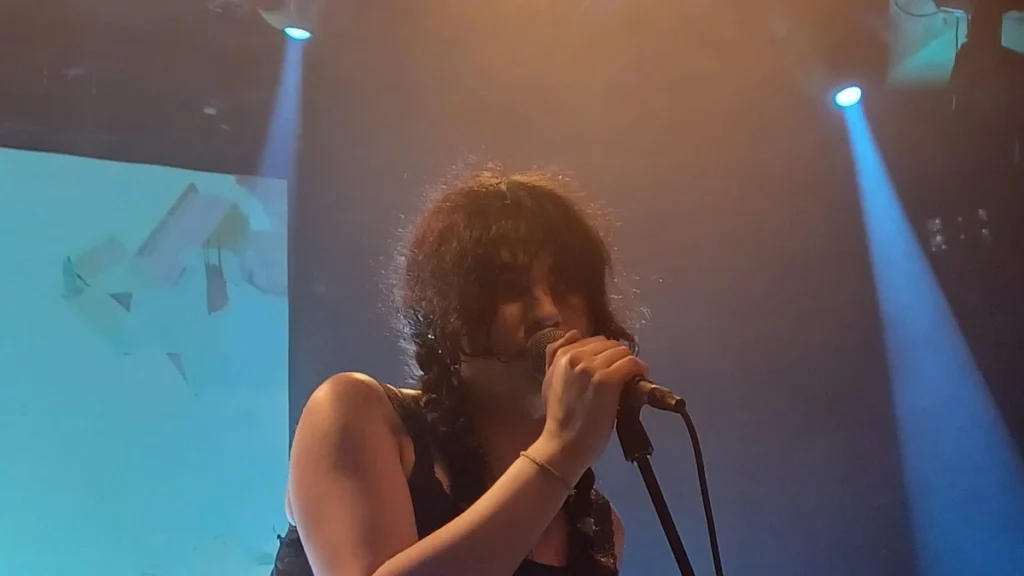
April Harper Grey has been explicit about what her third album is for. She wanted it suited to malls, airports, hotels and supermarkets, and has described the target as fluorescent, consumerist architecture. Her other formulation is better still: music for my iPhone spy movie.
U arrived on 20 March 2026 through Mom + Pop Music and Corporate Rockmusic, self-produced, and it was written in the middle of a touring schedule dense enough that those buildings were most of what she saw. Then she named the tour GALLERIA, which is a shopping arcade, in case the point had been missed.
The Opposite of the Last One
Wallsocket, in 2023, was a concept album with an invented Michigan town and a cast of characters, closer to folk narrative than to club music. U abandons that entirely. It is diaristic rather than fictional, and Grey has said it used a much simpler and more convenient recording setup than its predecessor.
That change of method is audible. Nine tracks run thirty-four minutes: Tell Me (U Want It), Music, Hollywood Forever, The Peace, Innuendo (I Get U), Lovefield, Do It, Bodyfeeling and Wish U Well. Four of them pass four minutes, which is long for the genre, and the record moves at the pace of somebody thinking rather than performing.
Recording in Transit
A simplified setup is what a musician adopts when the studio is wherever she happens to be. The practical constraint of making a record between shows is the thing that gives U its texture, because a laptop in a hotel produces different decisions than a booked room does.
That makes it a close relative of Nathan Fake building an album on an ancient Cubase rig and keeping the single takes. Both are records whose character comes from what the equipment allowed rather than from what the artist could have afforded, and in both cases the limitation reads as an aesthetic afterwards.
What the Songs Are About
The subject is the audience. Tell Me (U Want It) is Grey asking directly whether she is delivering what listeners want. Hollywood Forever sits with the pleasant parts of fame without apologising for them. Lovefield, which NME picked as the standout, is about wanting to be genuinely reachable. Bodyfeeling is about what the business costs.
She has put the underlying condition plainly, telling NME that she has always scrutinised herself as though she were famous, on the reasoning that someone is going to pick her life apart eventually so she had better prepare. That is a striking thing to say, and it explains why an album about parasocial attention does not read as a complaint.
Where the Sound Comes From
NME’s five-star review traced the palette across several decades: dubstep, EDM, harmoniser-processed vocal pop in the Imogen Heap manner, and guitar layered into electronics. Do It reaches back to noughties radio pop, complete with a breakdown lifted from the Justin Timberlake playbook.
The review made the point that matters most, which is that nothing on the album carries a clear temporal marker. A record assembled from twenty years of pop signifiers with none of them foregrounded sounds like no particular year, which is precisely the quality shared by the airports and shopping centres it was designed for. Those buildings are also built to feel like nowhere.
Corporate Rockmusic
The album was issued jointly by Mom + Pop Music and an imprint called Corporate Rockmusic, and the second name is not an accident on a record about consumerist space. A label credit is the one piece of an album’s presentation that nobody reads as authored, which makes it a useful place to put a joke that only lands for people paying attention.
The track titles work the same way. Tell Me (U Want It) and Innuendo (I Get U) both use the compressed second-person of a text message, and the album’s own title is a single letter that stands for the listener. Wish U Well closes it. Read down the sleeve and the record is addressed to somebody throughout, which is a peculiar and quite exposed thing for a pop album to do, and it is the reason the parasocial theme never has to be stated.
Hollywood Forever, at four minutes fifty-five, is the longest thing here and the only track named for a real place. It is also a cemetery in Los Angeles that hosts film screenings and concerts, which makes it exactly the kind of building the rest of the album is about: somewhere designed for one purpose and now used mostly as a venue.
An Eighty-Nine on Metacritic
The critical response was close to unanimous. Metacritic settled at 89. Pitchfork gave 8.6. NME and Dork both gave five stars, the Guardian gave four, and the Needle Drop scored it eight out of ten.
Chart positions were more modest, as they usually are for this kind of release: forty-three on UK album downloads, forty-one on US top album sales, sixty-three on North American college radio. The gap between an 89 and a number forty-one is the ordinary shape of a critically dominant record with a young, streaming-first audience that does not buy things.
Venues That Kept Getting Bigger
The touring tells a different story from the sales chart. Twenty North American dates were upgraded to larger rooms more than once because of demand, which is the clearest available measure of an artist’s actual standing.
The European run starts at Club To Club in Turin on 30 October and Le Trabendo in Paris the following night, then Paradiso in Amsterdam, Hole44 in Berlin, Luxor in Cologne and the Mira Festival in Barcelona. The British and Irish leg takes in the Grand Social in Dublin, Glasgow, the Brudenell Social Club in Leeds, Electric Brixton in London and Gorilla in Manchester on 14 November. umru supports throughout, and joins her again for three Australian theatre shows in Brisbane, Melbourne and Sydney in December.
The Singles Ran Nine Months
Music appeared in June 2025, Do It in November, and Tell Me (U Want It) in February 2026, a month before the album. Spreading three singles across nine months is a long campaign for a record this short, and it fits an artist whose audience arrived through the internet rather than through radio.
It also means the album had been partly heard by the time it landed, which suits material about the relationship between a performer and the people watching. By March the listeners had already spent most of a year with the questions the record was asking them.
Naming the Tour After the Building
GALLERIA closes the loop. An album written in transit, built to sound like commercial architecture, and then toured under the name of a shopping arcade is a single idea carried through the writing, the production and the marketing without anybody having to explain it.
Hyperpop has spent several years being described as a genre about excess and speed. What Grey has made instead is a record about a specific and very ordinary kind of emptiness, the sort produced by lit corridors, and it is the strongest argument yet that the style can carry something other than intensity.
That reframing is probably the album’s real contribution. The genre’s defining early records were maximal by instinct and were received as either a joke or a provocation, which left its artists arguing about legitimacy rather than about material. A self-produced album that scores 89 while being fundamentally about loneliness in transit ends that argument by ignoring it, and it does so without abandoning any of the production language the style was built on.
About The Author

 The Hip-Hop Dance-Pop Sound and Where It Went on Hold Me Close Now! By Gloria May Byron
  Why Chillwave Keeps Coming Back: Goodbye Gravity by Attaboy
  Why Synth-Pop Keeps Coming Back, as Shoshan Dunamis Shows on Have a Sense
  Bright Arpeggios Under a Heavy Heart, and How to Hear Them on LNNY’s Gehen Rafatape Remix
  Summer Shame: F. Scott’s Unearthly Opening Notes and Where They Went
  Four Versions of One Hook on What I Should See by Peter Agyagos, and How to Hear It