
Com Truise Has Worn Out Five Akai Controllers on Tour
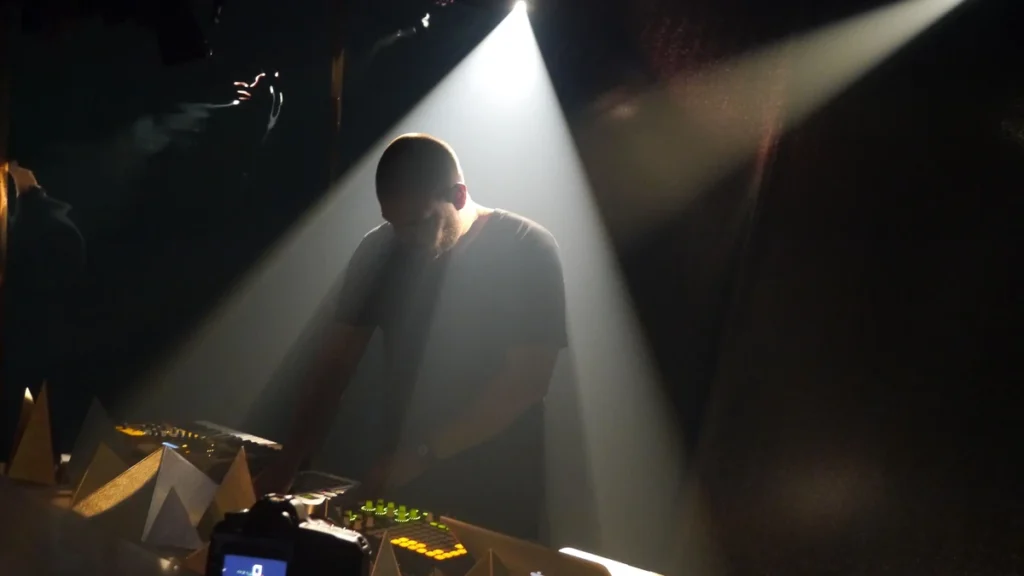
The Akai APC40 in front of him on stage is the sixth one. The previous five were destroyed by touring, which is the kind of detail that tells you more about a working musician’s life than any amount of discussion about influences.
Seth Haley has recorded as Com Truise since 2010, and the striking thing about his method is how little of it has moved. The controllers wear out. The workflow does not.
Reason In, Ableton Out
The core of it is a split that most producers abandoned a decade ago. He writes and sequences in Reason and records into Ableton Live, and his reason is disarmingly simple: he really likes the sequencer Reason has in it.
For years that meant exporting long loops out of Reason and into Ableton samplers, a genuinely awkward chain. A more recent upgrade let him put audio straight on the timeline, which he has said gave him more headroom and changed his sound. That is a rare thing to hear stated plainly, because producers usually attribute a change of sound to intent rather than to file routing.
The Juno and the Xpander
Two instruments do most of the work. The Roland Juno-106 is where songs start, and he has explained why in practical terms: if he wants to begin a melody he can switch it on and come up with something almost immediately.
The Oberheim Xpander is the other. He uses it on almost every song, and describes the appeal as its brightness and sharpness. Around those sit an Oberheim Matrix 6, a Crumar Bit One and a Korg ARP Odyssey reissue, with modular gear used occasionally.
A writing instrument you can turn on and immediately use, plus a signature timbre applied across the catalogue, is a smaller and more disciplined setup than the synthwave aesthetic usually implies. The genre’s imagery suggests wall-to-wall vintage racks. The actual method is two machines and a habit.
What He Takes on the Road
The live rig is chosen for survivability rather than for sound. Three Akai controllers handle Ableton, performance effects and the LED system, each fader on the APC40 running a separate track for drums, melody, effects, leads and bass.
The touring synth is a Dave Smith OB-6, which he added a week or two before a tour started and summarised as being all you really need to capture that sound. An Elektron Digitakt handles percussion and accents, chosen partly because its MIDI sync does not drift. The interface is a Focusrite Scarlett 2i2, picked because it is reliable and available in any shop in the world.
His stated logic for keeping it small is the sort of thing only somebody who has toured a lot says: when there is a lot to carry around, things break, and it makes him nervous. Five dead APC40s is what that sentence is based on.
The Visuals Run on the Same Laptop
Four LED panels are driven by Resolume, synced to Ableton through a custom interface built with Max MSP plugins, communicating over a closed Wi-Fi network so nothing depends on a venue’s connection.
He has acknowledged that running the graphics and the audio on one computer is taxing, which is an understatement. It also explains the visual identity: an artist who does his own design work, having previously been an art director, is not going to hand the screens to somebody else.
No Setlist
He does not tour an album. He has said outright that he never really got set up to take a record out on the road, and instead plays a cross-section of the catalogue that changes, morphing arrangements rather than working down a list.
The difficulty he names is the one every electronic act faces: making it interesting without making it so different from the record that the audience feels short-changed. Tour preparation, in his account, tends to consist of finding a piece of gear he likes and working out whether he can fit it in.
The Bedroom in Los Angeles
The studio itself has shrunk. He moved from a dedicated space in Brooklyn to a bedroom setup in Los Angeles, and a good deal of the synth collection went into storage rather than onto a desk, on the reasonable grounds that clutter is not a working method.
What replaced it was outboard processing, and he has been enthusiastic about the shift, saying he really enjoys turning an EQ or adding real compression to drums. That is a meaningful reorientation for a producer known for synthesisers: it moves the interesting decisions from choosing a sound to treating one.
It also fits the drums-first emphasis he keeps returning to. Asked about the comparisons his music attracts, he has pointed out that he focuses more on the drums than the reference points suggest, and compression on a drum bus is exactly where that focus becomes audible.
A Spoonerism and a Space Traveller
The name is a spoonerism of Tom Cruise. Haley was born in 1985, worked as an art director, and resigned before the Cyanide Sisters EP appeared in 2010 on AMDISCS, reissued the following year by Ghostly International. He had already released records as Sarin Sunday, SYSTM and Airliner.
Everything from that EP through Galactic Melt in 2011, In Decay, the Wave 1 and Silicon Tare EPs and Iteration in 2017 tells one continuous story about a synthetic astronaut called Com Truise escaping an oppressed society. Of Iteration he said there was a lot more air on the record, a lot more space.
Sustaining a single narrative across seven years and six releases is unusual, and it is the reason the catalogue rewards being played in order. His own description of the sound has stayed just as fixed: mid-fi synthwave slow-motion funk.
Ending the Story
Persuasion System arrived on Ghostly on 17 May 2019 and closed the arc. His label described the process as switching digital audio workstations and rebuilding his palette of sounds, and said he was leaving the past narrative behind.
Nine tracks run from the ninety-second Worldline to the nearly six-minute Privilege Escalation, taking in Gaussian, Ultrafiche of You, Kontex, Existence Schematic, Laconism and Departure. Metacritic settled at 71, AllMusic gave three and a half stars, and AllMusic’s Paul Simpson caught the balance exactly, writing that it signals a bit of a different approach without being different enough to alienate anyone.
It reached three on US Heatseekers, eight on US Vinyl Albums and ten on Top Dance Albums, which is a healthy result for an instrumental record on an independent.
Not Stranger Things
One correction he has had to make repeatedly: people write to him assuming he scored Stranger Things, and he has to explain that it was his friends in Survive. He distinguishes his own work by pointing out that he has more beats in it.
That is the accurate distinction. Where Perturbator took the same eighties palette toward metal, Haley took it toward funk, which is the harder move because it requires drum programming rather than volume. It is also why the gear list matters: the sound he is chasing lives in a specific Oberheim and a specific Roland, and the only way to get it is to own them and keep turning them on.
About The Author

 The Hip-Hop Dance-Pop Sound and Where It Went on Hold Me Close Now! By Gloria May Byron
  Why Chillwave Keeps Coming Back: Goodbye Gravity by Attaboy
  Why Synth-Pop Keeps Coming Back, as Shoshan Dunamis Shows on Have a Sense
  Bright Arpeggios Under a Heavy Heart, and How to Hear Them on LNNY’s Gehen Rafatape Remix
  Summer Shame: F. Scott’s Unearthly Opening Notes and Where They Went
  Four Versions of One Hook on What I Should See by Peter Agyagos, and How to Hear It